Temple of the Winds is the 4th book in Terry Goodkind's ongoing
Sword of Truth series, and the first book by him that I've read. I don't recommend starting a fantasy series at book 4, but this is the only one I had, and I had no trouble getting into the story even without having read any of the others.
I have blogged about Goodkind before, but
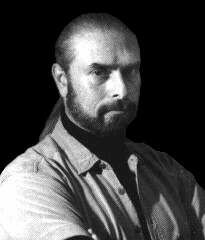
mostly just to make fun of his eloelable author photo. That picture really is him, and it really is on the back cover of this book. Unfortunately I've got the hardcover, and I took off the dust jacket while carrying this one back and forth to the gym for the 2 weeks it took me to get through it, so I didn't have his picture available to give me a laugh or pep me up mid-workout.
Ridiculous, "
Kneel before Zod" author photos aside, he's a fairly popular fantasy author, with one of the bigger fantasy series going, to his name. As my goal is to read something from every major fantasy author/series, I had to get through one of his books at some point, and since I'd had this book lying around for several years since getting it free at a library giveaway, I finally got to it. I enjoyed it, I guess. It wasn't very good, but it wasn't awful. I've read worse, though I've certainly read better.
After writing the below review, I looked at the Amazon.com page for the book, to see what the fans thought. Most of them are fans, and most of them love it. The book's got 257/444 5-star reviews, and a 4-star average. That said, I'm looking over some of the
5-star reviews to see what the lovers love it... I'm coming up blank.
I'm on the 4th page of them now, and I've yet to see one actually argue why it's a good book. They're all fanboy (more often fangirl) slop. Short reviews by people who love the whole series, and think this book is great cause it's more of the same. This doesn't mean their opinions aren't valid, but it does mean that they're useless for my purpose, which is to be convinced of the book's quality by a fan. A few argue against the common complaints about his books/writing (which I suppose I made myself), but most just talk about how much they love the characters, and how emotionally-affecting the book was. Personally, I thought the characters were flat and forgettable, and the book's emotional scenes were usually forced and tear-jerking, and were more told than shown. Which probably explains why my review scores are so much lower than theirs.
To the scores:
Temple of the Winds, by Terry Goodkind
Plot: 4
Concept: 6
Writing Quality/Flow: 4/6
Characters: 4
Fun Factor: 4
Page Turner: 5
Re-readability: 7
Overall: 6
This was the first (and probably last) novel I'd ever read by Goodkind, so all of my impressions of it, and him, and the series, came from this book. All I'd heard about him in the past was that this series is popular, but that it's getting less so as it stretches on to books 8 and 9. The complaints I've read are that Goodkind has gotten progressively more preachy as the series has gone along. In the more recent books he's inventing entire civilizations of wimpy non-fighters solely to serve as straw men he can demolish in his argument against pacifism; that sort of thing. I've not read those books, so I don't have an opinion on that issue.
As for this book, it's the 4th in the series, but I had no trouble starting off here. Background information is presented as necessary (usually more than necessary; I think a lot of the exposition would have been very boring if you'd read the first 3 books) and it's such a Fantasy 101 type of world that nothing really needs explanation anyway. The characters are all human and they all act in basically contemporary, secular ways. No one is motivated by unknown, unseen, bizarre things. Basically, there's no learning curve to get into the flow of the story. This is sort of a good thing, since it makes the book accessible to a new reader, but it's also lame, since it speaks to the general mediocrity of the creativity of the series. I think that a new reader should be somewhat lost if they start off with the 4th book in a long fantasy series, since enough of the world should have been built that new readers won't understand what's going on in at least some of the instances.
For a chance, I'll go over the rating points one by one, since this is probably the only Goodkind book I'll ever read, and I might as well be thorough.
Plot: 4What plot? I think I would have been thoroughly bored by this book if I'd read the others in the series. As it was I thought the story dragged quite often. The hardcover is 520 pages, and 350-400 pages would have been more than sufficient. Maybe 300, if things were really tightened up. The editing would be a pain though, since it's not like there are whole chapters or sub-plots to dump. Everything in the book is very linear; 95% of it takes place in the one capital city and stars the two main romantic leads, Richard and Kahlan. The other 5% is usually more interesting, since it does much more to advance the world state, talk about the larger war that's ramping up, present action and suspense, etc. Richard and Kahlan aren't exactly boring, but they're very conventional and feel like cardboard cut outs from some generic stock of fantasy novel characters.
The book's structure is similar to most of the books in the Wheel of Time series, though much less sweeping or involved. There are a few hundred pages of miscellaneous mundane activities, the narrative jumps from plot thread to plot thread (though the vast majority takes place in one location with 2 main characters), and then with about 50 pages to go the stagnation suddenly ends and everything comes suddenly to a head with a series of wild climaxes of action and conflict. This book doesn't end in a ridiculous cliff hanger, as most of the Wheel of Time books do, but the mad rush to tie up all of the loose ends in the last 20 pages certainly felt familiar. This was welcome coming after hundreds of pages of blandness, but the pacing was sub-optimal. More interesting stuff all throughout, next time. Kthxplz.
Concept: 6I probably gave this too high a score, but since this was the first novel (for me) in the series, all of the setting and world and type of magic and other elements were new to me. The actual plot events and happenings were pretty blah, though. Richard is trying to rule the land he's just unified, he's hoping to marry his love Kahlan, he's trying to learn to master his magic, enemy spies sent by the evil Dreamwalker wizard have released a plague, and a sadistic killer is loose in the city. The book is kind of about all of these things, but never really feels deeply involved with any of them, and there's not really any suspense or weight to the decisions made by the characters.
Writing Quality/Flow: 4/6Very workmanlike. Nothing very well-written, but it's not awful. If Goodkind has any quirks or trademarks as a writer, it's that he over-explains. Many times, especially over the first half of the novel, a chapter starts off with a paragraph of action (not that it's action-y action; usually just people walking around the castle, talking), and is followed by literally 2 or 3 pages of exposition in some character's thoughts. What's happening, why it's happening, how that character feels about it happening (this most of all), what might happen next, etc. This stuff is never entirely necessary, and I suspect most readers end up skimming it. I know I did, since I just didn't need to know it, and I wanted to get on with the action. Such as it was.
Goodkind's biggest writing weakness is the classic "telling rather than showing" issue. He almost always has characters talking or thinking about how angry, or in love, or scared, or desperate, etc, they are. It's never convincing, and I never felt any real attachment to the supposed love between the leads, since every page from one of their POVs has them repeatedly saying how much they are in love. It feels forced, like they're trying to talk themselves into it.
Goodkind doesn't always do this either, and it's much more effective when he does not. Towards the end of the book one character is being controlled by the evil Dreamwalker wizard, and while it's made very clear that the voices he's hearing are driving him to do evil things, it's left slightly to the reader to figure it out. The character's madness is therefore much more convincing and interesting, since we're not being beaten over the head with pages of him (or someone else) thinking about how oddly he's behaving, how he's changed without explanation, how it's almost like someone is giving him orders he can't help but follow, etc.
The other odd thing about the writing is that it's very bland and chaste and commonplace, and then every now and then we get a scene of fairly pornographic/sadistic violence. They're not quite shocking, since they seem consciously designed to titillate, but what's odd is that they feel out of place. The easy comparison is to martin's Fire and Ice series, where there is equally (or more) graphic violence and sex, but there it feels like a natural extension of the very adult, serious, realistic world. The gruesome scenes in this book, especially a torture/murder near the end, come out of nowhere and have a very different tone than the rest of the vanilla writing.
The analogy that came to my mind was deleted scenes on a DVD. It's like this book was edited to be PG-13, and was then released on an "unrated" DVD. It's the same movie, but several scenes of intense graphic violence were dropped in over the formerly hint and subtlety-filled scene from the family-friendly version. They were somewhat shocking in their different mood and tone, but they didn't feel an organic part of the whole, which ruined their impact.
Characters: 4It's odd; the characters were interesting in almost inverse proportion to their importance. Almost all of the minor characters in the subplots were far more interesting than the leads. Richard and Kahlan are totally blah. He's strong and heroic and determined, she's loyal and loving and fierce in a matronly way. Not awful, not Mary Sues, not boring, just very predictable and familiar. I felt like I'd seen them both in 50 novels (fantasy and otherwise) before this one.
The oddest thing about the book and the characters was how contemporary they all felt. Not in a fresh, vivid, realistic way, the way the characters in Martin's Ice & Fire series are; the characters in this one felt like actors in a mediocre movie. Never really possessed of strong emotions, not entirely sold on their parts, and usually just going through the motions. More than once I felt like it was sort of a reality show set in a Ren Faire. Like real people had been placed into a fantasy world, given light amnesia, and told this is who they really were. So they were living it, but without complete conviction or a real sense of authentic belonging.
This was partially due to the setting, since it felt like the modern world, set in castles with some magic. Male and female attitudes towards life were basically contemporary, no one was really scheming or vile, no one had archaic attitudes (as I expected), etc. It was kind of like Harry Potter in a way, or perhaps Harry Potter reversed. The fiction of that world is interesting since it's the modern world, with magic overlaid. So the characters, especially the kids, are very contemporary, but they use magic sometimes, and the reader is fully aware of the odd juxtaposition. In Goodkind's world the reverse seems to have happened. It's like modern characters are put into a magical world, but they're not allowed to be, or aren't supposed to be, modern.
In a way this book made me appreciate more some other fantasy series. I'm pretty hard on Jordan's Wheel of Time, but it's got so much better characters than this book. Jordan's are frustrating and maddening with their repetitious and predictable mannerisms, but they're distinctive and memorable. I already can't remember anything about any individual character in this book, and I finished reading it 2 days ago.
Fun Factor: 4Page Turner: 4Bleh. I read it at the gym, an hour a pop for about 2 weeks (I didn't go to the gym every day) and it held my interest, but I was never exactly eager to go an extra half hour on the cardio machine to get through another few chapters. I didn't enjoy it, but I didn't dislike it either. It was serviceable, but I've got no need to hunt up other books in the series.
Re-readability: 7I'm being generous on this one since if you enjoyed it and had read the rest of the series, you'd want to read it again to get every nuance. My personal score on this is a 0, since I'll never read it again, nor do I plan to read any of the rest of the series.
Overall: 6Again, kind of a generous score. This wasn't an awful book, and I read it without too much complaint (only the over explaining and over thinking early on disturbed me enough to groan and roll my eyes), but I can't recommend it and it's not in my top 10 fantasy world series.
Labels: book review